
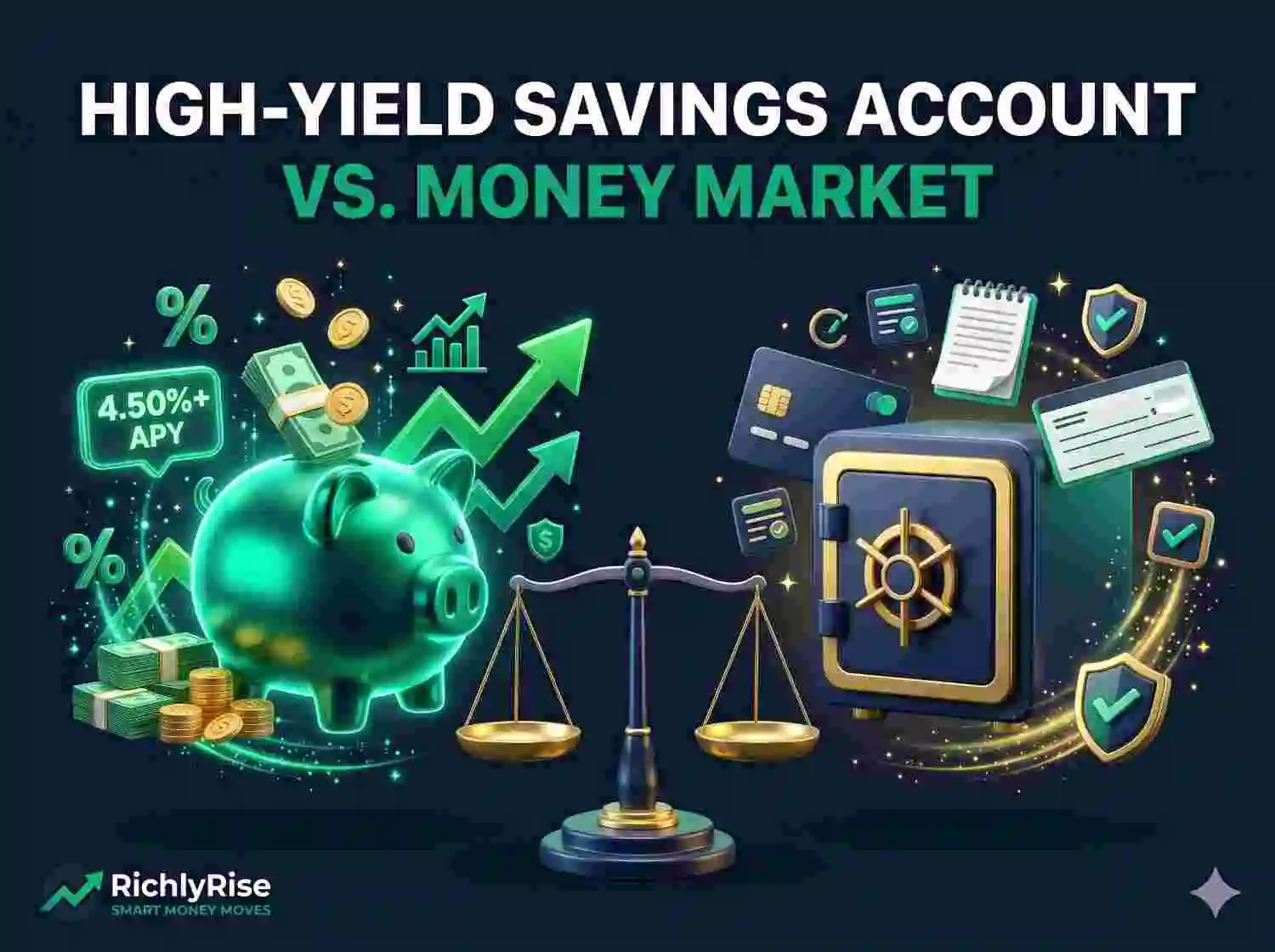
High-Yield Savings Account vs. Money Market Account: What Is the Difference?
In a high-yield savings account vs money market comparison, both pay 4.00% to 5.00%+ APY with identical FDIC, FSCS, or CDIC insurance, but a money market account includes direct debit card and check-writing privileges—usually in exchange for higher minimum balance rules—while a high-yield savings account focuses on $0-minimum pure digital growth.
You have completed the Master Guide, Step 1, and Step 2, and are now on Step 3 of 5:
- ✅ Master Guide (Completed): What Is a High-Yield Savings Account? (7 Proven Ways to 10x Cash)
- ✅ Step 1 (Completed): How Does a High-Yield Savings Account Work? 5 Smart APY Secrets
- ✅ Step 2 (Completed): High-Yield Savings Account vs. CD: 5 Costly Traps to Avoid
- 📍 Step 3 (Compare Checking Features): High-Yield Savings Account vs. Money Market YOU ARE HERE
- Step 4 (Tax Rules — US, UK & Canada): Do You Pay Taxes on a High-Yield Savings Account? 3 Crucial Rules →
- Step 5 (Final Verdict): High-Yield Savings Account Pros and Cons: 9 Essential Truths →
When Joci finally moved his emergency cash out of a sluggish big-bank account, he immediately hit a new crossroads while comparing two nearly identical offers side by side: an online high-yield savings account vs money market account paying the exact same 4.55% APY. At first glance, the interest rates looked identical, the federal deposit insurance badges matched, and neither account charged a monthly maintenance fee. Yet when Joci dug into the account agreements, he noticed something critical—one account came with a physical Visa debit card and paper checkbook for instant emergency contractor payments, while the other offered pure digital transfers with zero spending temptation and a $0 minimum deposit requirement.
Understanding the practical trade-offs in a high-yield savings account vs money market decision can save you from unexpected minimum-balance fees or delayed weekend transfers when an urgent bill strikes. While both accounts sit near the top of the safe cash hierarchy, they are engineered for slightly different daily habits and cash-flow styles.
If you have already compared a high-yield savings account vs CD in Step 2 of our series, you know why flexible access matters for emergency reserves. Today, we are breaking down every detail of a high-yield savings account vs money market account—including crucial legal distinctions between bank Money Market Accounts and brokerage Money Market Funds across the US, UK, and Canada.
High-Yield Savings Account vs. Money Market Account: 4 Key Differences
At their core, both products are interest-bearing deposit accounts designed to hold short-term cash safely while paying 10x more interest than traditional checking accounts. However, when you examine a high-yield savings account vs money market account closely, four clear structural differences determine which one belongs in your financial toolkit:
1. Direct Spending Access (Debit Cards & Check-Writing)
The single biggest functional difference in a high-yield savings account vs money market matchup is how you spend the money inside the account:
- Money Market Account (MMA): Acts like a hybrid between a checking account and a savings account. Most MMAs issue a physical debit card for ATM withdrawals or point-of-sale purchases and provide paper check-writing privileges. If your furnace breaks on a Saturday night and the repair technician wants a check on the spot, you can write it directly from your MMA without waiting 1 to 2 business days for an electronic bank transfer.
- High-Yield Savings Account (HYSA): Built strictly as a vault for saving, not spending. Almost no standalone HYSAs include check-writing, and very few issue debit cards. To spend funds from an HYSA, you initiate an electronic ACH, EFT, or Faster Payment transfer to your linked checking account first.
2. Minimum Deposit & Balance Thresholds
Because banks provide extra payment infrastructure (debit card networks, check clearing, and ATM access) on money market accounts, they often require larger balances:
- High-Yield Savings Account: Top digital HYSAs routinely feature $0 minimum opening deposits and $0 ongoing balance requirements to earn the advertised top APY. Whether you start with $25 or $50,000, every dollar earns the full rate.
- Money Market Account: Many banks require $1,000 to $10,000+ to open a money market account, waive a $10–$15 monthly maintenance fee, or unlock the highest advertised interest tier. Drop below that threshold, and your yield can plummet overnight.
3. Interest Rate Structure & Tiered APY Rules
When comparing yields in a high-yield savings account vs money market search, headline APYs look virtually neck-and-neck (typically 4.00% to 5.00%+ APY during elevated rate environments). However, the way banks apply those rates differs:
- HYSAs typically offer a clean, flat variable APY across your entire balance.
- Money Market Accounts frequently use tiered interest rate schedules—for example, paying 0.50% APY on balances under $5,000, 3.25% APY on balances between $5,000 and $24,999, and 4.60% APY only once your balance crosses $25,000.
4. Psychological Spending Friction (“Out of Sight, Out of Mind”)
Behavioral finance plays a massive role in whether your savings actually survive the year. When Joci tested a debit-card-enabled money market account for six months, he noticed how dangerously easy it was to swipe that card for non-emergencies—a flight sale here, an impulse weekend gadget there—telling himself he would “pay it back next month.” Moving his core safety net into a dedicated high-yield savings account with no debit card created just enough healthy friction to keep his emergency fund untouched.
| Feature | High-Yield Savings Account (HYSA) | Money Market Account (MMA) |
|---|---|---|
| Typical APY Range | 4.00% – 5.00%+ APY (usually flat rate) | 4.00% – 4.85%+ APY (often balance-tiered) |
| Debit Card & ATM Access | Rarely included | Yes — standard Visa/Mastercard debit card |
| Check-Writing Privileges | No | Yes — personal checks included |
| Minimum Balance Rules | $0 at top online banks | $1,000 to $10,000+ common |
| Monthly Transfer Limits | 6–10 free withdrawals/cycle at some banks | 6–10 free checks/transfers/cycle (ATM often unlimited) |
| Deposit Insurance | FDIC ($250k) / FSCS (£85k) / CDIC ($100k) | FDIC ($250k) / NCUA ($250k) insured |
Critical Warning: Money Market Account vs. Money Market Fund
One of the deadliest mistakes beginners make when researching a high-yield savings account vs money market option is confusing a bank Money Market Account (MMA) with a brokerage Money Market Fund (MMF). Although their names differ by just one word, they are governed by completely different laws and risk profiles:
- Money Market Account (Bank Deposit Product): Opened at a retail or online bank or credit union. Your cash is a bank deposit protected by federal insurance up to $250,000 per depositor under the FDIC Money Market Deposit Account Rules (or NCUA at credit unions). Your principal cannot lose value.
- Money Market Mutual Fund (Brokerage Investment Security): Purchased inside an investment brokerage account (such as Vanguard, Fidelity, Charles Schwab, Hargreaves Lansdown in the UK, or Wealthsimple/Questrade in Canada). As explained in the SEC Money Market Funds Investor Bulletin and FINRA Money Market Fund Guidance, a money market fund invests in ultra-short-term US Treasury bills and corporate commercial paper. While designed to maintain a stable $1.00 share price, money market funds are NOT FDIC-insured and carry slight market risk during extreme financial crises.
(Note for UK & Canadian Readers: Retail banks in the UK and Canada rarely use the US “Money Market Account” label for everyday savers. Instead, UK savers choose between Easy Access Savings Accounts and Money Market Funds inside a Stocks & Shares ISA, while Canadian savers compare High-Interest Savings Accounts [HISAs] against Cashable GICs and brokerage Money Market ETFs like CASH.TO or PSA.TO, all overseen by the FCA UK Banking & Savings Rules and FCAC Canadian Banking Guide).
Want to See All 7 Proven Ways to 10x Your Savings?
Before choosing between a high-yield savings account vs money market account, review our complete step-by-step blueprint on maximizing your safe cash reserves.
Read: What Is a High-Yield Savings Account? (Master Guide) →When a High-Yield Savings Account Wins
For roughly 80% of everyday savers, a dedicated high-yield savings account beats a money market account. Choose an HYSA when any of the following describe your financial setup:
- You Are Starting With Under $5,000: When evaluating a high-yield savings account vs money market account with a smaller starting balance, most money market accounts either hit you with a $10–$15 monthly fee or drop you into a low 0.50% interest tier. Top online HYSAs pay their full 4.50%+ APY starting from your very first $1.
- You Want Zero Impulse-Spending Temptation: Because an HYSA does not come with a debit card in your wallet, you cannot accidentally swipe your emergency fund during a weekend shopping trip. The 1-to-2 day ACH transfer buffer acts as an automatic cooling-off period that protects your long-term discipline.
- You Automate Weekly or Bi-Weekly Payday Transfers: High-yield savings accounts are built for automated wealth-building routines—letting you set up recurring transfers and organize separate digital sub-buckets for taxes, travel, home repairs, and medical deductibles.
- You Already Have a Free Checking Account: If you already use a zero-fee checking account for daily debit card swipes and bill pay, adding check-writing to your savings via a money market account is redundant. Keeping your checking and HYSA separate gives you cleaner accounting and stronger fraud protection (if your debit card is ever skimmed, thieves cannot drain your savings balance).
When a Money Market Account Wins
Even though an HYSA is simpler for most savers, a money market account has distinct tactical advantages when you hold larger cash reserves and need instant payment flexibility. Choose a money market account in a high-yield savings account vs money market decision when:
- You Keep $15,000 to $100,000+ in Liquid Cash: Once your balance comfortably clears a bank’s minimum threshold (typically $10,000 to $25,000), monthly maintenance fees disappear and you unlock top-tier APYs that match or slightly exceed standalone HYSAs.
- You Need Same-Day Check-Writing or ATM Cash Access: Landlords, small business owners, real estate investors, and homeowners undergoing major renovations frequently need to write large checks on the spot—such as earnest money deposits, contractor milestones, or quarterly estimated tax payments—without waiting two business days for funds to clear into checking.
- You Want a Single “All-in-One” Cash Hub: If you hate juggling multiple bank logins and want one high-interest account that handles occasional checks, ATM withdrawals, and savings growth under a single roof, a money market account delivers that hybrid convenience.
Which Account Fits Your Exact Cash Profile?
3 Hidden Traps to Check Before Opening Either Account
Before you finalize your high-yield savings account vs money market choice, run through this quick three-point checklist to ensure your yield stays protected:
- Monthly Withdrawal Caps: Even though US federal Regulation D limits were lifted, many banks still cap free outbound transfers, checks, and debit purchases on both HYSAs and money market accounts at 6 to 10 transactions per statement cycle, charging $5 to $15 for every extra transaction.
- Out-of-Network ATM Surcharges: If you pick a money market account for its debit card, confirm whether the bank reimburses out-of-network ATM fees or participates in a nationwide fee-free network like Allpoint or MoneyPass.
- Tax Reporting on Interest: Whether you earn $600 in an HYSA or $600 in a money market account, tax authorities treat the payout identically—learn the exact reporting rules in our next guide on whether you pay taxes on a high-yield savings account, or review our full checklist of high-yield savings account pros and cons before locking in your primary bank.
FAQs on High-Yield Savings Accounts vs. Money Market Accounts
1. In a high-yield savings account vs money market comparison, which pays a higher APY? +
Both offer nearly identical top rates (typically 4.00% to 5.00%+ APY at leading online banks). However, a high-yield savings account usually pays that top APY with a $0 minimum balance, whereas a money market account often requires $10,000 to $25,000+ to unlock its highest interest tier.
2. Can I use a money market account as my primary checking account? +
Not recommended. While money market accounts include debit cards and checks, many banks restrict outbound checks, debit swipes, and ACH transfers to 6–10 per month. Use a dedicated checking account for daily bills and keep your money market or HYSA for reserves.
3. Is a money market account safer than a high-yield savings account? +
No—both have identical safety when opened at an FDIC-insured bank or NCUA-insured credit union (up to $250,000 per depositor). Only brokerage money market mutual funds lack FDIC insurance.
4. Do UK and Canadian banks offer money market accounts? +
Retail banks in the UK and Canada rarely use the US “Money Market Account” label. Instead, UK savers use Easy Access Savings Accounts (FSCS-insured up to £85,000) and Canadian savers use High-Interest Savings Accounts [HISAs] (CDIC-insured up to CAD $100,000), while accessing money market yields through brokerage funds or ETFs.
5. Should I put my emergency fund in an HYSA or a money market account? +
In a high-yield savings account vs money market decision for emergency funds, choose an HYSA if you want $0 minimums and protection against impulse debit-card spending, or choose a money market account if you hold $15,000+ and want instant check-writing during emergencies.
Complete High-Yield Savings Account Series Directory
You have completed four guides in this series. Continue to the final 2 guides below:
| Guide Title | What You Will Master | Next Step |
|---|---|---|
| What Is a High-Yield Savings Account? | Core definition, 5-year math & FDIC/FSCS/CDIC safety | ✓ Completed |
| How Does a High-Yield Savings Account Work? | Daily compounding mechanics & APY vs. interest rate | ✓ Completed |
| High-Yield Savings Account vs. CD | Liquidity trade-offs, fixed rates & withdrawal penalties | ✓ Completed |
| High-Yield Savings vs. Money Market | Debit card access, check-writing & minimum balances | — |
| Do You Pay Taxes on an HYSA? | US 1099-INT, UK Personal Savings Allowance & Canada T5 | Read Guide → |
| High-Yield Savings Account Pros & Cons | Complete 9-point checklist & who should open one | Read Guide → |
How Much of Your 4.50%+ APY Does the Taxman Take?
Now that you know how to choose between an HYSA and a Money Market account, master the exact US 1099-INT, UK Personal Savings Allowance, and Canadian T5 tax rules in Step 4:

Entrepreneur, founder, and strategist behind Richly Rise. Dedicated to breaking down personal finance concepts, debt-elimination strategies, and actionable wealth-building frameworks.