
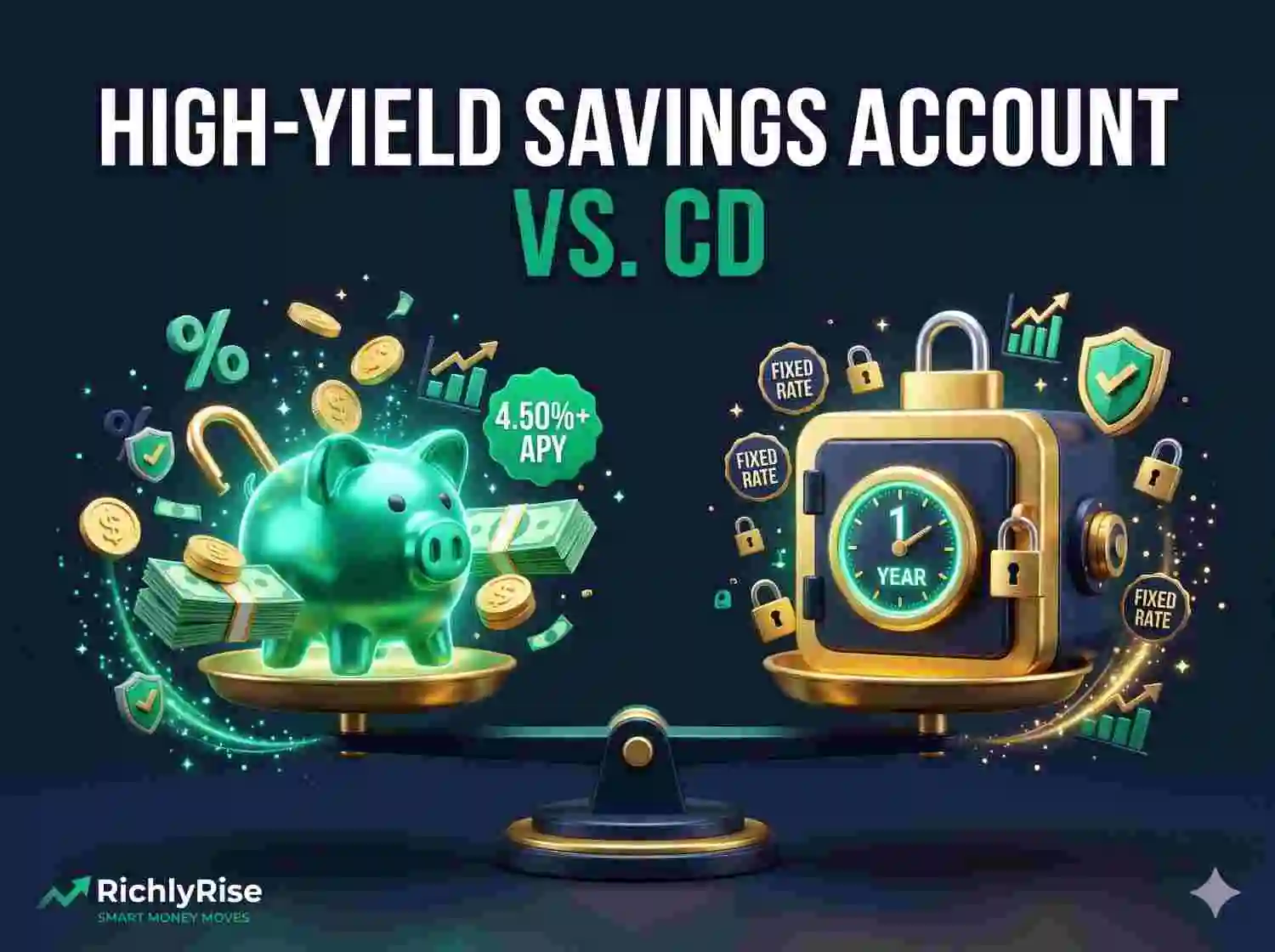
High-Yield Savings Account vs. CD: Which One Is Better?
When comparing a high-yield savings account vs CD (Certificate of Deposit), a high-yield savings account wins for emergency funds and flexible cash you may need at any moment with zero withdrawal penalties, while a CD wins when you want to lock in a guaranteed fixed APY for 6 months to 5 years before interest rates drop.
You have completed the Master Guide and Step 1, and are now on Step 2 of 5. Follow the remaining guides below:
- ✅ Master Guide (Completed): What Is a High-Yield Savings Account? (7 Proven Ways to 10x Cash)
- ✅ Step 1 (Completed): How Does a High-Yield Savings Account Work? 5 Smart APY Secrets
- 📍 Step 2 (Compare Locked Rates): High-Yield Savings Account vs. CD YOU ARE HERE
- Step 3 (Compare Checking Features): High-Yield Savings Account vs. Money Market: 4 Key Differences →
- Step 4 (Tax Rules — US, UK & Canada): Do You Pay Taxes on a High-Yield Savings Account? 3 Crucial Rules →
- Step 5 (Final Verdict): High-Yield Savings Account Pros and Cons: 9 Essential Truths →
Last autumn, Joci spotted a bank banner promising 5.15% APY on a 12-month Certificate of Deposit—nearly half a percent higher than the 4.65% APY his high-yield savings account was paying at the time. Eager to squeeze every last dollar out of his $18,000 cash reserve, he moved the entire lump sum into the 12-month CD without reading the early exit clause. Four months later, an unexpected roof repair and vehicle replacement hit in the same week, forcing Joci to break the CD early—and the bank wiped out 180 days of interest in a single penalty deduction, leaving him with less than he would have earned in a regular savings account.
That expensive lesson highlights why understanding the real trade-offs in a high-yield savings account vs cd comparison is essential before you lock up a single dollar. While both accounts offer government deposit insurance and far higher yields than traditional checking accounts, they solve two completely different financial jobs.
If you have already read our guide on how a high-yield savings account works, you know how daily compounding fuels flexible savings. Now let’s compare a high-yield savings account vs cd side by side—including UK Fixed Rate Bonds and Canadian GICs—so you never fall into a liquidity trap.
High-Yield Savings Account vs. CD: Side-by-Side Comparison
Before diving into fine-print traps, look at how a high-yield savings account vs cd stacks up across liquidity, interest rate behavior, minimum deposits, and deposit insurance across the US, UK, and Canada:
| Feature | High-Yield Savings Account (HYSA) | Certificate of Deposit (CD / Bond / GIC) |
|---|---|---|
| Interest Rate Type | Variable APY (changes with central bank rates) | Fixed APY (locked for 3 months to 5 years) |
| Cash Access & Liquidity | Withdraw anytime penalty-free | Locked until maturity date |
| Early Withdrawal Penalty | $0 / £0 | 60 to 365 days of forfeited interest |
| Adding Extra Money Later | Yes — deposit weekly or monthly anytime | No — one-time lump sum at opening |
| Typical Minimum Deposit | $0 to $100 | $500 to $2,500+ |
| Government Insurance | FDIC ($250k) / FSCS (£85k) / CDIC ($100k) | FDIC ($250k) / FSCS (£85k) / CDIC ($100k) |
US, UK & Canada Terminology: CDs vs. Fixed Rate Bonds vs. GICs
If you live outside the United States, banks use different labels for the exact same time-locked product when comparing a high-yield savings account vs cd:
- 🇺🇸 United States — Certificate of Deposit (CD): Issued by banks (or Share Certificates at credit unions) and protected up to $250,000 per depositor by the FDIC Certificate of Deposit Consumer Guide. Standard terms range from 3 months to 5 years.
- 🇬🇧 United Kingdom — Fixed Rate Bond: Offered by UK banks and building societies with FSCS protection up to £85,000. Unlike US CDs that charge an interest penalty for early exit, many UK Fixed Rate Bonds strictly prohibit early withdrawals altogether until maturity except in severe financial hardship.
- 🇨🇦 Canada — Guaranteed Investment Certificate (GIC): Protected up to CAD $100,000 under the CDIC GIC Deposit Protection rules. Non-redeemable GICs lock your cash for 1 to 5 years at top rates, while “Cashable GICs” allow early exit after 30 to 90 days at a lower yield.
5 Costly Traps to Avoid in a High-Yield Savings Account vs. CD Decision
When evaluating a high-yield savings account vs cd, most savers focus solely on the headline APY and overlook five hidden traps that quietly erode returns:
Trap 1: Locking Up Your Emergency Fund
Your emergency fund has one job: instant availability during a job loss, medical bill, or urgent home repair. Putting emergency cash into a locked CD defeats its purpose. Keep 3 to 6 months of core living expenses inside a liquid high-yield savings account first—only consider CDs for surplus cash above that safety net.
Trap 2: Harsh Early Withdrawal Penalties That Eat Principal
If you break a 1-year or 2-year CD early, banks typically charge 90 to 180 days of simple interest (and up to 365 days on 5-year CDs). Worse, if you withdraw during the first two months before you have accrued enough interest to cover the fee, the bank deducts the shortfall directly from your original principal—meaning you actually walk away with less cash than you deposited.
Trap 3: Automatic Rollover Into a Low-Yield Term
When a CD matures, most banks give you a brief 7-to-10-day grace period to withdraw or move your money. If you miss that window, the bank automatically renews your funds into a brand-new CD of the same term—often at a terrible default “standard” rate (sometimes 0.25% APY instead of the 4.50% promotional rate you originally signed up for).
Trap 4: Ignoring “Callable” CD Fine Print
Brokerage CDs sometimes advertise yields 0.40% higher than standard bank CDs because they are callable. A callable CD gives the issuing bank the right to cancel your CD early if interest rates drop—handing your cash back to you right when rates are lowest, stripping away the exact rate protection you wanted.
Trap 5: Single Lump-Sum Lockup When Rates Are Uncertain
Putting 100% of your spare cash into a single 3-year CD leaves you stuck if rates jump next quarter, whereas keeping 100% in an HYSA leaves you exposed if central banks slash rates. You can solve both problems at once using a CD Ladder.
Not Sure How Much Cash Should Stay Liquid?
Before locking a single dollar into a Certificate of Deposit, calculate your exact 6-month survival buffer so an unexpected bill never forces an early withdrawal penalty.
Calculate Your Exact Emergency Fund Target →How to Combine Both: The 4-Rung CD Ladder + HYSA Strategy
Instead of treating a high-yield savings account vs cd as an all-or-nothing choice, savvy savers combine both tools. Keep your primary emergency fund in an HYSA, and split your medium-term cash (for example, $20,000 earmarked for a home renovation or car purchase over the next 1 to 2 years) into four equal $5,000 CDs maturing every 3 months:
The $20,000 Quarterly CD Ladder Blueprint
With this setup, a fresh $5,000 chunk unlocks every 90 days—giving you regular penalty-free cash windows while locking in high fixed yields. Remember that interest earned from both HYSAs and CDs is taxable in the year it is credited; review our breakdown on whether you pay taxes on a high-yield savings account to plan ahead for tax season.
Decision Matrix: When to Pick an HYSA vs. a CD
Still weighing a high-yield savings account vs cd for your next transfer? Match your exact goal below:
- Choose a High-Yield Savings Account if:
- You are building or holding your 3-to-6 month emergency fund.
- You plan to add money every payday via automatic transfers.
- You expect central banks to keep rates steady or raise them.
- You want one-click transfers to your checking account with zero lockup dates (verified via the CFPB Deposit Account Guidance and FCA Savings Consumer Information).
- Choose a Certificate of Deposit (CD / Fixed Bond / GIC) if:
- You already have a fully funded emergency fund in a separate HYSA.
- You have a specific lump sum earmarked for a goal 6 to 36 months away (such as a wedding, tuition bill, or house down payment).
- Central banks are actively cutting interest rates and you want to lock in today’s 4.50%+ APY before variable HYSA rates drop.
- You are tempted to impulse-spend your savings and want a built-in lock to protect your discipline.
FAQs on High-Yield Savings Accounts vs. Certificates of Deposit
1. In a high-yield savings account vs CD comparison, which pays higher interest right now? +
Short-term 6-to-12 month CDs and top high-yield savings accounts pay very similar rates (often within 0.10% to 0.35% of each other). However, a CD guarantees that exact APY for the entire term, whereas an HYSA’s variable rate can rise or fall at any time.
2. What is a “No-Penalty CD” and how does it compare to an HYSA? +
A No-Penalty CD locks in a fixed APY while letting you withdraw your full balance penalty-free starting 6 to 7 days after funding. The catch is that you usually must withdraw the entire balance at once (partial withdrawals aren’t allowed) and you cannot add new monthly deposits like you can in an HYSA.
3. Are CDs safer than high-yield savings accounts? +
No—both carry identical government insurance protection. Whether your money sits in an HYSA or a CD at a regulated institution, your principal is protected up to $250,000 by the FDIC (US), £85,000 by the FSCS (UK), or CAD $100,000 by the CDIC (Canada).
4. Can I add money to my CD every month like a savings account? +
With standard CDs, no—you fund the account once when opening it. (Rare “Add-On CDs” allow extra deposits, but usually pay lower interest rates). If you want to save monthly from your paycheck, use a high-yield savings account.
5. How are CD interest earnings taxed compared to an HYSA? +
Both are taxed identically as ordinary interest income in the year the interest is credited to your account—even if your multi-year CD hasn’t matured yet and you haven’t withdrawn the cash.
Complete High-Yield Savings Account Series Directory
You have completed the first three guides in this series. Continue to the remaining 3 guides below:
| Guide Title | What You Will Master | Next Step |
|---|---|---|
| What Is a High-Yield Savings Account? | Core definition, 5-year math & FDIC/FSCS/CDIC safety | ✓ Completed |
| How Does a High-Yield Savings Account Work? | Daily compounding mechanics & APY vs. interest rate | ✓ Completed |
| High-Yield Savings Account vs. CD | Liquidity trade-offs, fixed rates & withdrawal penalties | — |
| High-Yield Savings vs. Money Market | Debit card access, check-writing & minimum balances | Read Guide → |
| Do You Pay Taxes on an HYSA? | US 1099-INT, UK Personal Savings Allowance & Canada T5 | Read Guide → |
| High-Yield Savings Account Pros & Cons | Complete 9-point checklist & who should open one | Read Guide → |
Want High APY Plus Debit Card & Check-Writing Access?
Now that you know when to keep cash liquid vs. locked in a CD, see how high-yield savings accounts stack up against Money Market Accounts in Step 3 of our series:

Entrepreneur, founder, and strategist behind Richly Rise. Dedicated to breaking down personal finance concepts, debt-elimination strategies, and actionable wealth-building frameworks.