
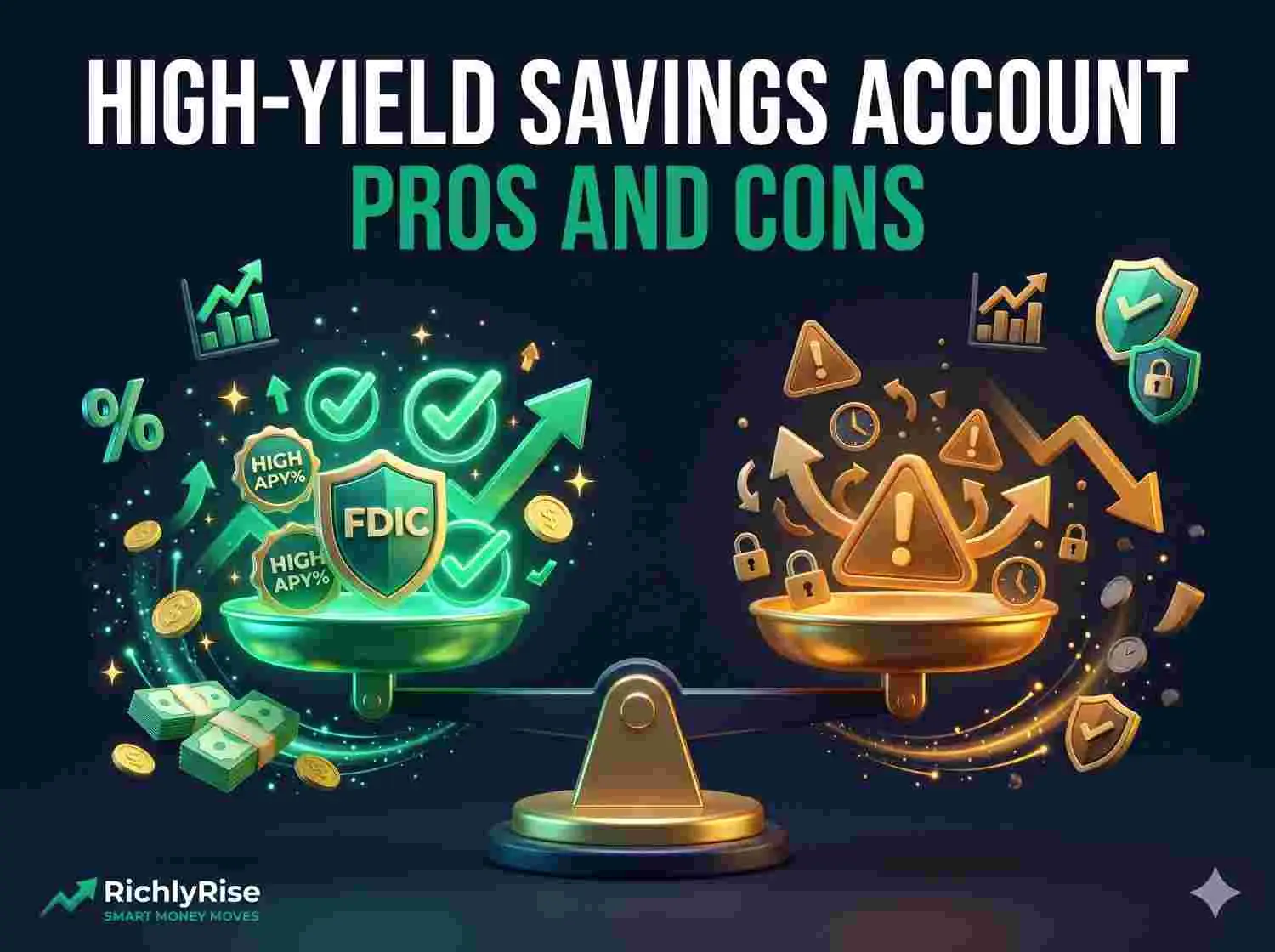
High-Yield Savings Account Pros and Cons: Are They Worth It?
When weighing high-yield savings account pros and cons, the biggest advantages are 4.00% to 5.00%+ APY (10x higher than big banks), zero-risk FDIC, FSCS, or CDIC deposit insurance, and penalty-free liquidity—while the main drawbacks are variable interest rates that drop when central banks cut rates, no physical branch tellers, and 1-to-2 day external transfer times.
Congratulations! You have completed the Master Guide and Steps 1–4, and reached the Final Chapter (Step 5 of 5):
- ✅ Master Guide (Completed): What Is a High-Yield Savings Account? (7 Proven Ways to 10x Cash)
- ✅ Step 1 (Completed): How Does a High-Yield Savings Account Work? 5 Smart APY Secrets
- ✅ Step 2 (Completed): High-Yield Savings Account vs. CD: 5 Costly Traps to Avoid
- ✅ Step 3 (Completed): High-Yield Savings Account vs. Money Market: 4 Key Differences
- ✅ Step 4 (Completed): Do You Pay Taxes on a High-Yield Savings Account? 3 Crucial Rules
- 🏁 Step 5 (Final Verdict): High-Yield Savings Account Pros and Cons YOU ARE HERE
Three years after Joci first moved his idle savings out of a brick-and-mortar bank paying 0.01% APY, his emergency fund had generated more than $3,400 in passive interest without risking a single penny in the stock market. Yet the journey wasn’t completely friction-free. Along the way, he watched his bank’s variable APY dip twice after central bank rate cuts, experienced a 48-hour weekend ACH delay when trying to move money on a Friday afternoon, and had to remind himself that a savings account is built to beat inflation—not replace long-term stock market compounding.
That real-world balance is why examining high-yield savings account pros and cons honestly matters before you transfer your cash. Most bank advertisements only show you the shiny 4.75% APY headline, while skeptics often exaggerate minor inconveniences and leave their money rotting at 0.01%.
Across our complete High-Yield Savings Account Master Guide, we have covered how a high-yield savings account works, compared a high-yield savings account vs CD, analyzed a high-yield savings account vs money market account, and broken down whether you pay taxes on a high-yield savings account. Now, in this final chapter, let’s examine all 9 essential high-yield savings account pros and cons so you can make a confident decision.
The 5 Biggest Advantages (Pros) of a High-Yield Savings Account
When evaluating high-yield savings account pros and cons, five undeniable strengths make an HYSA the undisputed foundation of modern cash management:
Pro 1: 10x to 400x Higher Interest Than Traditional Brick-and-Mortar Banks
The primary reason millions of savers switch is raw mathematical return. Traditional megabanks spend billions maintaining physical marble branches and legacy infrastructure, passing that cost onto customers via microscopic 0.01% to 0.05% APY rates. Because online high-yield banks operate lean digital platforms, they pass those savings directly to you in the form of 4.00% to 5.00%+ APY. On a $25,000 balance, that difference puts $1,125+ per year in your pocket instead of $2.50.
Pro 2: 100% Government Deposit Insurance (Zero Principal Loss)
Unlike stocks, crypto, or corporate bonds, your principal in a regulated high-yield savings account cannot drop in value during a market crash. Whether you bank in the US, UK, or Canada, your cash is backed by sovereign deposit protection:
- 🇺🇸 United States: Insured up to $250,000 per depositor, per insured bank, per ownership category through the FDIC Deposit Insurance Coverage Rules (or NCUA at federal credit unions).
- 🇬🇧 United Kingdom: Protected up to £85,000 per eligible person, per authorized institution under the FSCS Deposit Protection Scheme.
- 🇨🇦 Canada: Covered up to CAD $100,000 per insured category via CDIC Deposit Protection.
Pro 3: Complete Liquidity With Zero Early Withdrawal Penalties
Unlike a Certificate of Deposit (CD), UK Fixed Rate Bond, or non-redeemable Canadian GIC that locks your money away for 6 months to 5 years, a high-yield savings account keeps your money 100% accessible whenever life throws a curveball. If your car transmission fails, your pet needs emergency surgery, or you lose your job, you can transfer your cash out without paying a single dollar in early exit penalties.
Pro 4: $0 Monthly Maintenance Fees & $0 Minimum Balances
Many traditional banks charge $5 to $15 per month unless you maintain a minimum daily balance—meaning if your balance is small, bank fees actually eat more money than you earn in interest. Nearly all leading online high-yield savings accounts feature $0 monthly maintenance fees, $0 account opening fees, and $0 minimum balance requirements to earn the advertised top APY.
Pro 5: Daily Compounding & Automated Sub-Buckets
Most high-yield savings accounts compound interest daily and credit it to your balance monthly, meaning your interest immediately begins earning interest of its own. Even better, top digital platforms allow you to split a single account into labeled digital “buckets” or “vaults” (Emergency Fund, Property Taxes, Vacation, Car Replacement) so you can track multiple financial goals without opening ten separate bank accounts.
| ✅ 5 Major Pros (Advantages) | ⚠️ 4 Real Cons (Drawbacks) |
|---|---|
| 1. 10x+ Higher APY: 4.00%–5.00%+ vs. 0.01% at big banks. | 6. Variable Interest Rates: APY drops when central banks cut rates. |
| 2. Government Insured: FDIC ($250k) / FSCS (£85k) / CDIC ($100k). | 7. No Physical Branches: Online/app-only support; cash deposits harder. |
| 3. Penalty-Free Access: Withdraw cash anytime without CD exit fees. | 8. 1–2 Day Transfer Lag: External ACH transfers pause on weekends. |
| 4. $0 Monthly Fees: No minimum balance traps at top online banks. | 9. Not a Wealth Multiplier: Won’t match long-term stock market returns. |
| 5. Daily Compounding & Buckets: Automatic sub-goal tracking. | Net Verdict: Essential for emergency & 1–3 yr cash! |
The 4 Real Drawbacks (Cons) of a High-Yield Savings Account
To make a balanced, clear-eyed decision when weighing high-yield savings account pros and cons, you also need to understand four real limitations that can frustrate unprepared savers:
Con 1: Variable Interest Rates Can Drop Without Warning
Unlike a fixed-rate Certificate of Deposit, UK Fixed Rate Bond, or Canadian GIC, the APY on a high-yield savings account is variable. Whenever the U.S. Federal Reserve, Bank of England, or Bank of Canada cuts benchmark interest rates, online banks typically lower their savings APYs within days or weeks—without needing your permission. If you want to lock in today’s yield for 1 to 3 years, review our comparison of a high-yield savings account vs CD.
Con 2: No Physical Bank Branches for In-Person Cash Deposits
Because top-paying HYSAs are offered primarily by digital-first institutions, you cannot walk into a neighborhood branch to hand cash to a human teller or get a cashier’s check printed on the spot. While many online banks partner with ATM networks (such as Allpoint or MoneyPass) or retail cash-deposit counters, depositing large amounts of physical paper cash is far less convenient than keeping a local brick-and-mortar checking account linked to your HYSA.
Con 3: 1-to-2 Business Day External Transfer Delays
If your checking account and your high-yield savings account sit at two different banks, moving money between them via standard ACH or EFT transfers usually takes 1 to 2 business days—and transfers initiated on Friday evening or during a bank holiday won’t settle until the following business week. (For immediate same-day debit card and check-writing access, see how a high-yield savings account vs money market account compares).
Con 4: Not Designed to Outpace Long-Term Stock Market Growth
While a 4.50% APY protects your purchasing power against everyday inflation, after accounting for income taxes—explained in our guide on whether you pay taxes on a high-yield savings account—your real inflation-adjusted return is modest (typically 1% to 2%). An HYSA is a safety and liquidity tool, never a substitute for diversified index funds or retirement investing over 10-to-30 year horizons.
Is a High-Yield Savings Account Right for Your Money?
- Your 3-to-6 month emergency survival fund
- A house down payment needed within 1–3 years
- Quarterly tax reserves, insurance, or tuition sinking funds
- Idle cash currently sitting at 0.01% in a big bank
- Money you won’t touch for 7+ years (use index investing)
- Daily debit card swipes and automatic utility bill pay
- Cash you want locked at a fixed APY during rate cuts (use a CD)
- Frequent physical cash deposits from a cash business
Final Verdict on High-Yield Savings Account Pros and Cons
When you weigh all nine high-yield savings account pros and cons side by side, the conclusion is unmistakable: every household should hold its emergency fund and 1-to-3 year goal cash in a high-yield savings account. Pairing a free local checking account (for daily spending and cash deposits) with an online HYSA (for 4.50%+ APY growth) gives you the best of both worlds—instant everyday convenience combined with maximum government-insured yield.
FAQs: High-Yield Savings Account Pros and Cons
1. What is the biggest downside in high-yield savings account pros and cons? +
The biggest drawback when reviewing high-yield savings account pros and cons is that the interest rate is variable—meaning your bank can lower your APY whenever central banks cut interest rates—and external transfers to another bank take 1 to 2 business days.
2. Can you lose money in a high-yield savings account? +
No. As long as your account is held at an FDIC-insured bank ($250,000 limit in the US), FSCS-authorized bank (£85,000 limit in the UK), or CDIC-member institution (CAD $100,000 limit in Canada), your principal is 100% protected against bank failure and market drops.
3. Does opening a high-yield savings account hurt your credit score? +
No. Opening a savings account only triggers a soft identity verification (or ChexSystems check), which has zero impact on your FICO or credit score.
4. Is it worth switching banks for a 4.50% APY if I only have $2,000 saved? +
Yes. At 4.50% APY, $2,000 earns $90 per year with zero monthly fees—compared to $0.20 at a big bank—and builds the automated habit that compounds as your balance grows to $10,000 and $25,000+.
5. How many high-yield savings accounts should one person have? +
Most savers only need one primary high-yield savings account that offers built-in digital savings buckets (unless your total cash exceeds $250,000 in the US, £85,000 in the UK, or CAD $100,000 in Canada, in which case splitting funds across two institutions keeps 100% of your cash insured).
Complete High-Yield Savings Account Series Directory (All 6 Guides)
Revisit any chapter in our complete High-Yield Savings Account Mastery Series below:
| Guide Title | What You Mastered | Status |
|---|---|---|
| What Is a High-Yield Savings Account? | Core definition, 5-year math & FDIC/FSCS/CDIC safety | ✓ Review Guide |
| How Does a High-Yield Savings Account Work? | Daily compounding mechanics & APY vs. interest rate | ✓ Review Guide |
| High-Yield Savings Account vs. CD | Liquidity trade-offs, fixed rates & withdrawal penalties | ✓ Review Guide |
| High-Yield Savings vs. Money Market | Debit card access, check-writing & minimum balances | ✓ Review Guide |
| Do You Pay Taxes on an HYSA? | US 1099-INT, UK Personal Savings Allowance & Canada T5 | ✓ Review Guide |
| High-Yield Savings Account Pros & Cons | Complete 9-point checklist & who should open one | 🏆 Series Complete |
You’ve Mastered High-Yield Savings — Ready for Your Next Smart Money Move?
Put what you learned into action today, or explore our complete Personal Finance library on RichlyRise to optimize your budget, emergency fund, and investing roadmap:

Entrepreneur, founder, and strategist behind Richly Rise. Dedicated to breaking down personal finance concepts, debt-elimination strategies, and actionable wealth-building frameworks.