
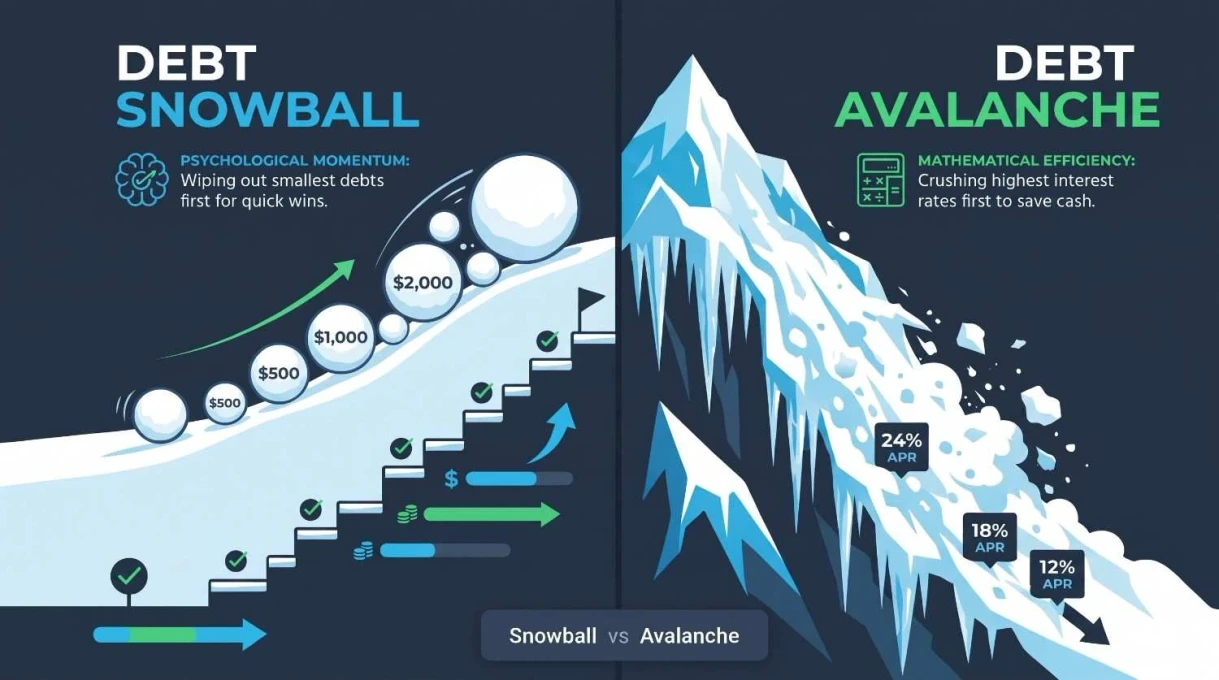
When you are trapped under multiple credit card balances, personal loans, and mounting monthly bills, choosing between the debt snowball vs avalanche method can mean the difference between lasting financial freedom and perpetual burnout.
If you are struggling to decide whether the psychological momentum of the debt snowball or the cold, pure mathematics of the debt avalanche is right for your financial journey, you are in the exact right place.
I know the suffocating feeling firsthand. A few years ago, my monthly paycheck felt like a brief optical illusion—it arrived on the first of the month and evaporated into minimum payments by the fifth. I had multiple debt accounts: two credit cards running ruthless 36% APRs, an unsecured personal loan, and a lingering retail installment balance. The anxiety was relentless. It wasn’t until I sat down, laid out my numbers, and methodically evaluated the debt snowball vs avalanche frameworks that I took back absolute control of my cash flow.
In this comprehensive 10x guide, we will break down the exact mechanics, behavioral psychology, and pure mathematical trade-offs between the debt snowball vs avalanche strategies. You will see real-life case studies, clear comparison tables, actionable step-by-step payoff roadmaps, and an interactive structural breakdown designed to help you crush debt permanently.
The Topic Cluster Context: Where This Fits in Your Wealth Journey
This comprehensive debt-elimination blueprint serves as Rule #3 of our foundational wealth architecture:
Where This Fits in Your Financial Roadmap
Follow this step-by-step master roadmap to systematically eliminate debt and scale long-term wealth:
Once your high-interest debt is conquered, you will deploy liberated cash flow into our High-Yield Savings Accounts Guide and scale long-term assets using our Disciplined Wealth Mindset Framework.
Before choosing between the debt snowball vs avalanche, ensure you have completed Rule #2 by locking in a starter cash buffer of at least one month of bare-bones living expenses. Attempting to accelerate either debt payoff strategy without a liquid cash buffer leaves you vulnerable to the first unexpected auto repair or medical bill, forcing you straight back into debt.
The Joci Story: My Awakening from the Minimum Payment Trap
Back in late 2021, my financial dashboard was an operational nightmare. I had four distinct liabilities draining my income:
- Credit Card Alpha: $1,500 balance at 34% APR (Minimum payment: $50)
- Personal Consolidation Loan: $8,000 balance at 14% APR (Minimum payment: $210)
- Credit Card Beta: $3,500 balance at 28% APR (Minimum payment: $110)
- Appliance Store Financing: $800 balance at 0% APR (Expiring promo; Minimum payment: $40)
Every month, $410 vanished just to keep these accounts current. The principal balances barely budged. I was working long hours, but my hard work wasn’t converting into wealth—a hard reality I break down in our deep-dive on Why Hard Work Alone Won’t Make You Rich.
I spent weeks endlessly researching the debt snowball vs avalanche debate. Half of the personal finance books preached the cold calculus of eliminating highest-interest balances first, while behavioral economists argued that human beings need quick psychological wins to stay motivated over a multi-year horizon.
To determine which path suits your mindset, let us examine how both strategies operate under the hood.
Strategy #1: The Debt Snowball Method (Behavioral Psychology First)
The debt snowball method prioritizes human psychology and quick emotional victories over interest rate optimization. Developed and popularized by financial author Dave Ramsey, this framework instructs you to list all non-mortgage debts in order of smallest balance to largest balance, completely ignoring interest rates.
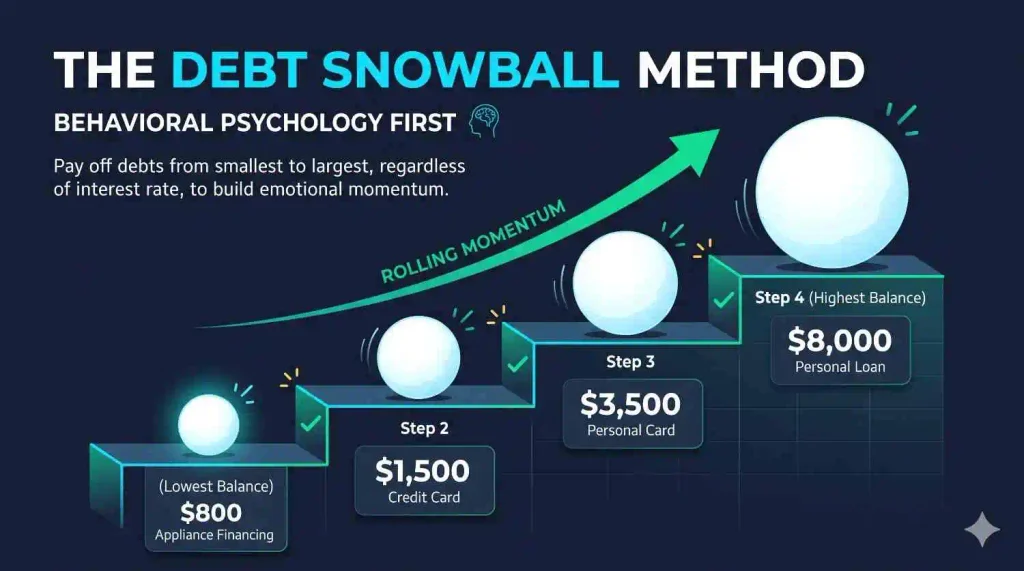
How the Debt Snowball Operates in 4 Steps
Follow this sequence strictly to build rapid psychological momentum and clear your smaller balances first.
List Your Debts 📋
Write down every single outstanding non-mortgage debt. Sort them strictly from the smallest balance to the largest balance, completely ignoring the interest rates (APR) for now.
Pay Minimums Across the Board 🔄
Set up automatic payments to meet the minimum required on all your debt accounts, except for the smallest one. It is vital to never miss these to keep your account status in good standing.
Attack the Smallest Balance ⚡
Direct every spare rupee—from side hustles, overtime, or your 50/30/20 budget savings—straight at that first, smallest target until it hits zero.
Roll the Snowball ❄️
Once that first debt is wiped out, take its entire monthly payment amount (minimum + any extra you were adding) and apply it to the next smallest debt on your list. Watch your snowball grow!
Why the Snowball Works: The Science of “Micro-Wins”
According to empirical research published in the Journal of Consumer Research (Harvard Business Review Analysis on Debt Payoff Motivation), consumers who tackle small balances first are significantly more likely to eliminate their overall debt load than those attempting purely mathematical approaches.
Eliminating an entire debt account closes a cognitive tab in your brain. You receive one less bill in your mailbox, manage one less online account login, and experience a tangible surge of dopamine that fuels your stamina for the bigger balances ahead.
Strategy #2: The Debt Avalanche Method (Pure Mathematical Efficiency)
The debt avalanche method takes the opposite view: it is an uncompromising, mathematically optimal framework. In the debt snowball vs avalanche comparison, the avalanche approach targets interest rates rather than balance sizes.
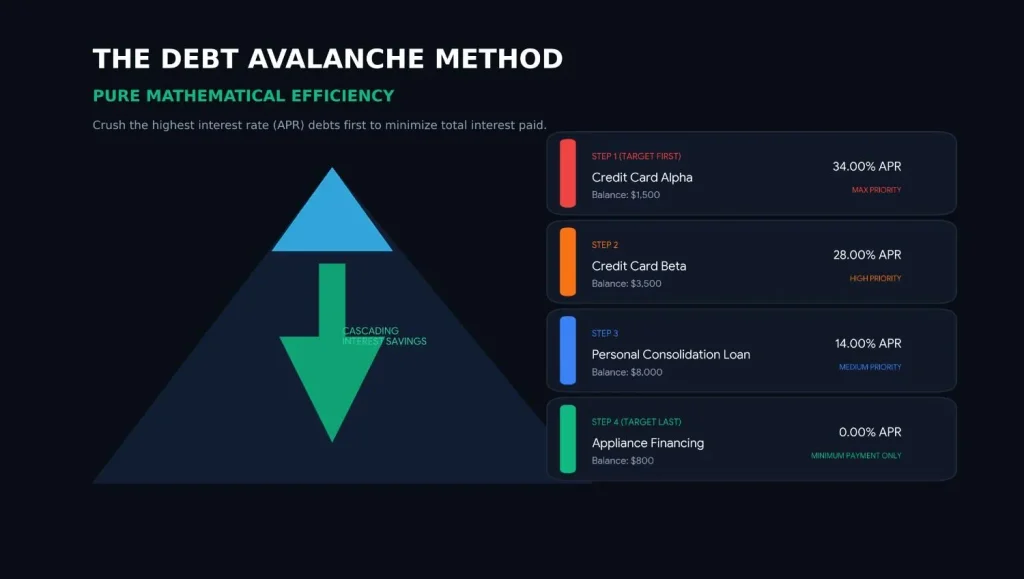
How the Debt Avalanche Operates in 4 Steps:
How the Debt Avalanche Operates in 4 Steps
Follow this strict mathematical sequence to destroy compound interest and maximize your total cash savings.
Rank by APR 📊
Order your debts strictly from the highest annual percentage rate (APR) down to the lowest APR, regardless of the balance size. Toxic high-interest balances go straight to the top.
Lock In Minimums 🔒
Pay the mandatory minimum payment on all accounts except the one charging the highest interest rate. This ensures your credit score stays protected and late fees are completely avoided.
Execute Aggressive Payments 🎯
Funnel every available dollar of monthly surplus directly into the balance with the highest APR. Attack this balance relentlessly until it is reduced to zero.
Cascade the Savings ⛰️
When your highest-APR balance is eliminated, roll its entire monthly payment power into the next highest interest rate account. The interest savings cascade faster with every debt cleared!
Why the Avalanche Works: Defeating Compound Interest
Interest charged on credit cards compounds daily. When evaluating the debt snowball vs avalanche through raw financial efficiency, the avalanche method is the undisputed champion. By eliminating toxic 28% to 36% APR balances immediately, you stop wealth destruction at the source. This preserves capital that will later fund your compound growth journey through disciplined investing and Stop-Loss Risk Management.
Head-to-Head Comparison: Debt Snowball vs Avalanche
To truly understand how the debt snowball vs avalanche methods stack up, let us examine a side-by-side comparison across every critical metric:
Real-Life Case Study: The Math in Action
To demonstrate the real-world difference in the debt snowball vs avalanche debate, let us run an objective financial simulation using a common $20,000 multi-card scenario.
The Debt Portfolio Profile:
The $20,000 Debt Portfolio Profile
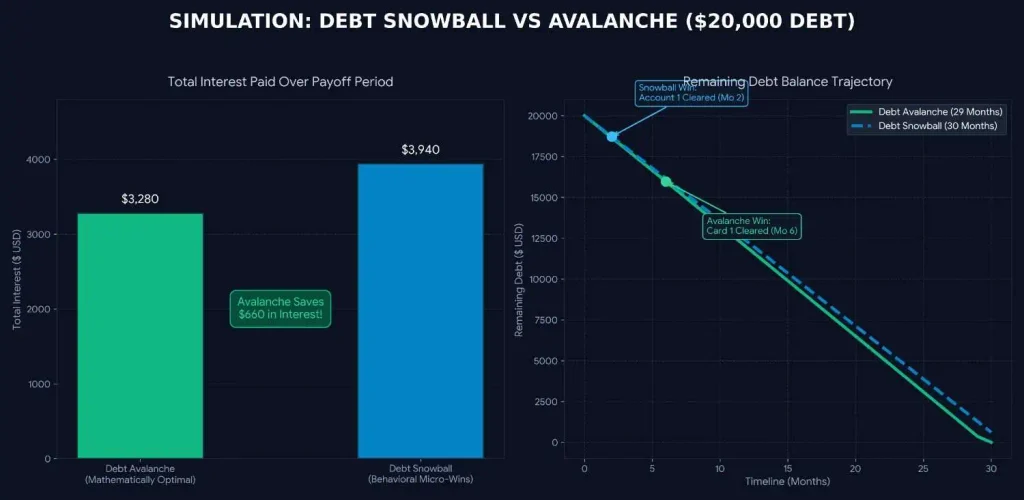
Snowball vs. Avalanche: The Battle Order
The Simulation Verdict
The Simulation Verdict:
⚖️ The Simulation Verdict
• Total Interest Paid: ~$3,280
• First Account Cleared: Month 6
• Total Interest Paid: ~$3,940
• First Account Cleared: Month 2 (Ultra-fast!)
In this real-world scenario, the debt avalanche saves $660 in cash and finishes 1 month earlier. However, the debt snowball eliminated its first account in just 60 days—giving you an instant psychological win compared to 6 grueling months of waiting under the avalanche.
💡 Mid-Article Action Step: Take Control of Your Cash Flow Today
Before you choose your strategy, you must know your exact surplus income. Download our free, automated budget tracker and streamline your numbers in under 10 minutes.
👉Download the Free Richly Rise Monthly Wealth & Debt Planner (Google Sheets)
How to Choose: Which Method Fits Your Financial Archetype?
The decision between the debt snowball vs avalanche is not merely a mathematical exercise; it is an assessment of self-awareness.
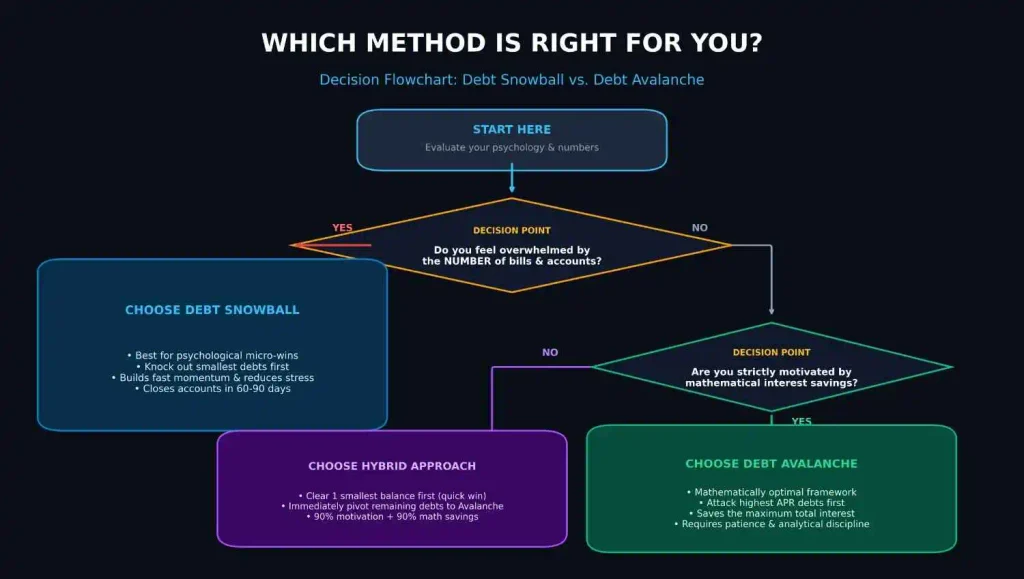
Choose Debt Snowball If:
- Overwhelmed by complexity: You manage 6+ cards/loans and need to simplify account clutter fast.
- Struggle with consistency: You need visible, dopamine-driven wins within 60–90 days to stay committed.
- Smallest balance is clearable: Your lowest debt can be eliminated rapidly, building early psychological momentum.
Choose Debt Avalanche If:
- Strictly analytical: Paying unnecessary compound interest drives you crazy; you prefer raw math efficiency.
- Highest APR is manageable: Your toxic 30%+ cards can be attacked without feeling impossible.
- Stable surplus income: You have an emergency fund and can wait 5–6 months for your first account to clear.
The Hybrid Alternative: The “Snow-Flake” Optimization Strategy
What if you don’t want to make an all-or-nothing choice between the debt snowball vs avalanche? You can use a hybrid model:
- Phase 1 (The Quick Win): Target your single smallest balance first, regardless of APR. Clear it within 60 days to prove to yourself that the system works.
- Phase 2 (The Avalanche Pivot): Once that emotional victory is secured, immediately reorganize all remaining debts by interest rate and execute the debt avalanche.
This hybrid approach captures 90% of the psychological benefit of the snowball while securing 90% of the mathematical savings of the avalanche.
5 Critical Rules to Follow During Either Payoff Strategy
Regardless of which direction you lean in the debt snowball vs avalanche evaluation, these foundational rules are non-negotiable:
- Stop Adding New Debt: You cannot bail out a sinking boat while drilling new holes in the hull. Freeze your credit cards, remove saved card details from online shopping accounts, and transition strictly to debit or cash.
- Never Miss a Minimum Payment: While attacking your target debt, every other account must receive its minimum payment on time. Set up automated payments to protect your credit profile. For an overview of credit scoring mechanics, consult the Consumer Financial Protection Bureau (CFPB) Credit Resource.
- Protect Your Baseline Liquidity: Maintain your starter cash safety net. If you encounter an emergency and have no savings, you will be forced to swipe the very credit cards you are trying to pay off.
- Negotiate APR Reductions: Call your credit card issuers and request a lower interest rate. If you have maintained a positive payment history, card issuers will often lower your APR by 3% to 7%, dramatically accelerating both the debt snowball vs avalanche timelines. Detailed negotiation scripts can be referenced via the National Foundation for Credit Counseling (NFCC).
- Re-route Payments After Zero Debt: When your final debt is cleared, do not absorb that freed-up cash into lifestyle inflation. Immediately redirect that monthly sum into compounding assets, high-yield accounts, and index funds.
Comparison Summary: At-a-Glance Reference
DEBT SNOWBALL VS. DEBT AVALANCHE
Executive Comparison & Strategic Takeaway Matrix
❄️ DEBT SNOWBALL
BEHAVIORAL- Rapid psychological dopamine wins within 60 to 90 days.
- Eliminates bill quantity and reduces money anxiety fast.
- Proven highest real-world habit completion rate.
- Suboptimal math (costs more in total interest paid).
- Leaves dangerous high-APR debt compounding longer.
⛰️ DEBT AVALANCHE
MATH OPTIMAL- Mathematically optimal (saves the most total cash).
- Accelerates final debt-free timeline significantly.
- Attacks and kills toxic 25%+ APR balances first.
- Requires ruthless personal discipline and patience.
- May take 6+ months before closing the first account.
💡 GOLDEN RULE: The best debt payoff method is the one you actually follow to completion without quitting.
To quickly review how each method behaves under operational stress:
Frequently Asked Questions (FAQ)
Can I combine both the Debt Snowball and Debt Avalanche methods? +
Should I build an emergency fund before starting debt payoff? +
Will closing paid-off credit cards hurt my credit score? +
What should I do once all my non-mortgage debts are cleared? +
Final Thoughts: The Best Strategy Is the One You Stick With
When weighing the debt snowball vs avalanche, personal finance commentators love to argue over spreadsheets and psychology. But here is the unfiltered reality: the best debt payoff method is the one you will actually follow to completion.
If saving $500 over two years excites you and you have the analytical discipline to push through months without closing an account, run the debt avalanche.
If you are emotionally drained, staring at half a dozen accounts, and need to see concrete, undeniable progress by next month, run the debt snowball.
Do not allow analysis paralysis to delay your start. Pick your framework, lock in your minimum payments, automate your monthly surplus, and take the first decisive step toward permanent financial independence today.
5 Golden Rules Every Beginner Must Know ↗
You’ve cleared the debt drag! Continue to Rule #4 below or click the title above to return to the Master Guide:
Click Rule 4 above to start compounding your wealth, or return to the 5 Golden Rules Master Blueprint.
Take Action: Calculate Your Exact Debt-Free Date
Download our automated Debt Payoff & Budgeting Spreadsheet to compare your timeline under Snowball vs. Avalanche in under 5 minutes.

Entrepreneur, founder, and strategist behind Richly Rise. Dedicated to breaking down personal finance concepts, debt-elimination strategies, and actionable wealth-building frameworks.